

June 2026
This month Guild members were treated to an utterly fascinating talk with slides by our prime dyer Glenis Price.
This was not just a history lesson about the 11th century art piece which was engrossing in itself but was also an eye opening lesson in colour theory.
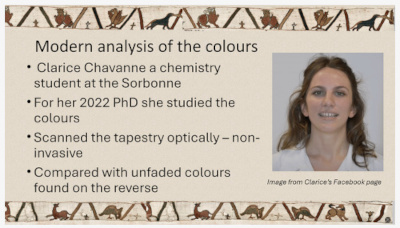
Glenis, and her husband Bob, had been intrigued by a BBC documentary about the Mysteries of the Bayeux Tapestry which featured a young French chemistry PhD student, Clarice Chavanne, who took minute samples of each colour from the back and least faded areas of the work and spectrally analysed each one to give the RGB colour values. .
Glenis found herself wondering how the wool in the embroidery (most certainly not a tapestry) was actually dyed almost 1000 years ago to create the original colours.
Using Clarice’s PhD thesis, Glenis, with some help from husband Bob and Photoshop, decided to recreate the RGB colours in dye form. A massive challenge taking many months of trial and error using natural dyes and traditional old breed sheep wool. RGB colours are known as ‘Additive colours’, red, green and blue, the light rays used in screens etc. Pigments are known as ‘Subtractive colours’, red, blue and yellow, so some difficult spectral and visual conversions were required.
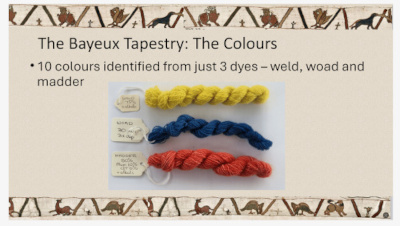
The palette is quite small, only 10 colours were identified by Clarice, and Glenis found almost all were possible to recreate from just three natural dyes, weld (yellow), woad (blue) and madder (red).
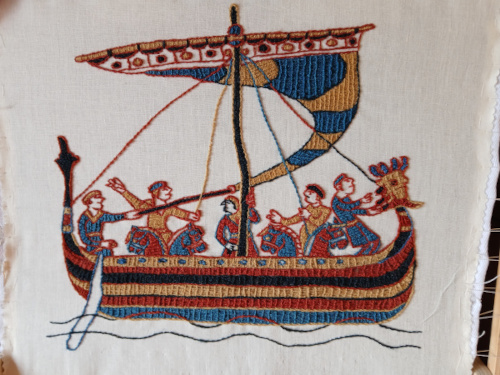
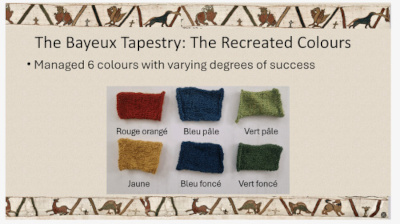
After a good six months Glenis was able to reproduce a small section of the embroidery using her own dyed wools. The piece she chose to copy using her dyed wools is a stunning reproduction, not to scale, of a sailing ship with a beautiful sail, a crew of five men and a cargo of four war horses.





Leave a Reply